Shipping Container Dimensions: 20ft, 40ft, High Cube & 45ft (2026 Guide)
Last updated: 2026-06-22
Quick answer: A standard 20ft container has internal dimensions of about 5.90 × 2.35 × 2.39 m (~33 m³); a 40ft is 12.03 × 2.35 × 2.39 m (~68 m³) — the same width and height, just twice the length. A 40ft High Cube adds 30 cm of height (2.69 m, ~76 m³), and a 45ft High Cube stretches the length to 13.56 m (~86 m³).
The number that decides how much you can actually load is the internal dimension, not the external one. Below are the full specs — internal, external, door opening, volume and weight — for every container you’re likely to ship in. For the complete reference across containers, trailers and rail wagons (in feet and metres), see the container dimensions reference.
Dimensions are only half the answer. What matters is how much of your cargo fits inside them. Enter your box or pallet sizes in ContainerMath to see the volume and fill for each container. Free to try, no card.
Container dimensions comparison
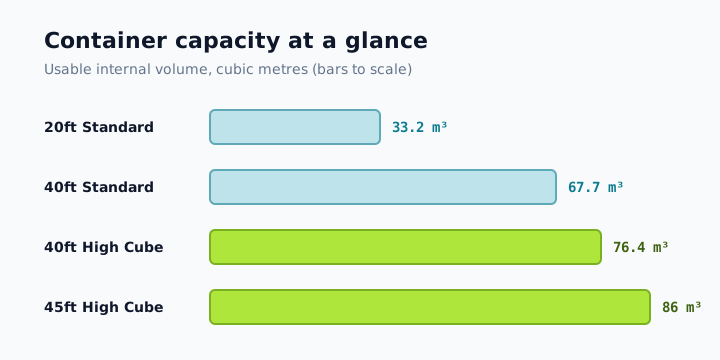
The 40ft holds roughly double a 20ft; the extra height of a High Cube adds ~13% more volume on the same floor.
| Spec | 20ft Standard | 40ft Standard | 40ft High Cube | 45ft High Cube |
|---|---|---|---|---|
| Internal length | 5.90 m / 19’ 4" | 12.03 m / 39’ 5" | 12.03 m / 39’ 5" | 13.56 m / 44’ 6" |
| Internal width | 2.35 m / 7’ 8" | 2.35 m / 7’ 8" | 2.35 m / 7’ 8" | 2.35 m / 7’ 8" |
| Internal height | 2.39 m / 7’ 10" | 2.39 m / 7’ 10" | 2.69 m / 8’ 10" | 2.69 m / 8’ 10" |
| Door opening (W × H) | 2.34 × 2.28 m | 2.34 × 2.28 m | 2.34 × 2.58 m | 2.34 × 2.58 m |
| Volume capacity | ~33.2 m³ | ~67.7 m³ | ~76.4 m³ | ~86 m³ |
| Tare (empty) weight | ~2,280 kg | ~3,800 kg | ~3,980 kg | ~4,800 kg |
| Max payload | ~28,200 kg | ~26,680 kg | ~26,500 kg | ~27,700 kg |
| Max gross weight | 30,480 kg | 30,480 kg | 30,480 kg | 32,500 kg |
External dimensions are fixed by the ISO standard — a 20ft is 6.06 m long and a 40ft 12.19 m, both 2.44 m wide. Standard height is 2.59 m; a High Cube is 2.90 m. You load to the internal numbers above.
Internal vs external — why the gap matters
Container walls, corner posts and flooring eat 15–20 cm off each external dimension. That’s why a “40-foot” box gives you 12.03 m of usable length, not 12.19 m, and why a pallet that looks like it should fit on paper sometimes won’t once you account for the real internal width of 2.35 m.
Reefers lose more again: insulated walls and the built-in cooling unit shrink the interior — mostly in width — and add to the tare. See reefer container dimensions for the interior figures and reefer container weight and capacity for what that costs in payload.
The door opening is smaller still — about 2.34 m wide and 2.28 m high on a standard container. Tall or wide items have to clear the door, not just the interior, so always check the door opening for out-of-gauge cargo.
How dimensions translate into load capacity
Dimensions are only the starting point. What actually fits depends on your cargo footprint and weight:
- Pallets: a 20ft holds about 11 Euro or 9 standard pallets in a single layer; a 40ft about 25 Euro or 20–22 standard.
- Boxes: depends entirely on carton size — see how many boxes fit in a container for the math and worked examples.
- Volume: convert your cargo to cubic metres first and compare it against the capacity column above.
Notice the payload column: every container caps at a 30,480 kg gross weight, so dense cargo hits the weight limit long before it fills the volume. A 40ft holds ~68 m³ but only ~26.5 tonnes — that’s why heavy goods (tiles, liquids, machinery) often ship in a cheaper 20ft.
Don’t plan a load from a dimensions table alone
A spec table tells you the box; it doesn’t tell you whether your cargo fits, how to stack it, or whether you’ll overload an axle. ContainerMath is a 3D load planner that takes your real carton and pallet sizes and weights and returns a 3D load plan across 20ft, 40ft, 40ft HC, 45ft, reefer and truck/road vessels — with live volume and payload utilisation.
See it packed in 3D — free trial →
Frequently asked questions
What are the internal dimensions of a 20ft container?
About 5.90 m long × 2.35 m wide × 2.39 m high, for roughly 33.2 m³ of volume and a maximum payload near 28,200 kg.
What are the internal dimensions of a 40ft container?
About 12.03 m long × 2.35 m wide × 2.39 m high — same width and height as a 20ft, double the length — for roughly 67.7 m³ and a payload around 26,680 kg.
What’s the difference between a 40ft and a 40ft High Cube?
Same length and width, but the High Cube is 30 cm taller (internal height 2.69 m vs 2.39 m), which lifts volume from ~67.7 m³ to ~76.4 m³. It’s the better choice for light, voluminous cargo that runs out of space before weight.
How big is a 45ft High Cube container?
Internal dimensions of roughly 13.56 × 2.35 × 2.69 m, about 86 m³, with a payload near 27,700 kg — the longest standard intermodal box, popular for high-volume, low-density freight. Note it is rated to a 32,500 kg max gross rather than the 30,480 kg of the 20/40ft boxes, which is why its payload is higher than a 40ft’s despite the heavier tare.
 ContainerMath
The industry standard for 3D container cargo packing and loading plans. Optimize layouts, maximize volume, and reduce shipping overhead.
Built by Backrock Studios