How Many Pipes Fit in a Shipping Container? 20ft and 40ft Counts
Last updated: 2026-10-11
Quick answer: Nested in staggered rows, a 20ft container holds 511 lengths of 110 mm plastic pipe, 143 of 200 mm, 52 of 315 mm or 12 of 630 mm (5.8 m lengths). A 40ft high cube holds 574, 165, 59 and 12 of the same sizes in 11.8 m lengths. Plastic pipe almost always fills the space long before it reaches the payload limit. Steel pipe is the opposite: a 40ft container takes only 80 lengths of 6-inch steel line pipe before it hits its weight limit, with the box less than half full.
Get the count for your own pipe sizes. Enter diameters, lengths and weights in ContainerMath and see how many fit, nested or square, in any container or trailer. Free to try, no card.
Pipe counts by size and container
These counts come from the ContainerMath packing engine, not from dividing volumes. Every pipe runs lengthwise, tight to the front wall, with the stack built in staggered rows that sit in the grooves of the row below.
Assumptions: HDPE (PE100) pipe, SDR 17, density 0.96 g/cm³. 5.8 m lengths in a 20ft container and 11.8 m lengths in a 40ft. Interior sizes are the standard ISO figures from our container dimensions guide.
| Pipe OD | 20ft (5.8 m) | 40ft (11.8 m) | 40ft high cube (11.8 m) |
|---|---|---|---|
| 110 mm | 511 | 511 | 574 |
| 160 mm | 238 | 238 | 266 |
| 200 mm | 143 | 143 | 165 |
| 250 mm | 92 | 92 | 102 |
| 315 mm | 52 | 52 | 59 |
| 400 mm | 30 | 30 | 35 |
| 500 mm | 20 | 20 | 24 |
| 630 mm | 12 | 12 | 12 |
The 20ft and 40ft counts are identical because the two boxes share the same cross-section, 2.35 m wide and 2.39 m high. A 40ft simply carries every pipe twice as long. Even the heaviest row in the table, 511 × 11.8 m of 110 mm pipe, weighs only about 12.2 t. That is less than half the 40ft’s payload. Plastic pipe is a space problem, not a weight problem.
The high cube’s extra 30 cm of height adds one to three courses, depending on diameter. At 630 mm it adds nothing: four nested courses already reach 2.27 m in the standard box, and a fifth would need 2.81 m, more than the high cube’s 2.70 m.
Nested vs square stacking
There are two ways to stack round pipe. Square stacking sits each pipe directly on the crown of the one below, in a grid. Nested stacking (also called hex, pyramid or valley stacking) offsets every second row by half a diameter, so each pipe sits in the groove between two below it.
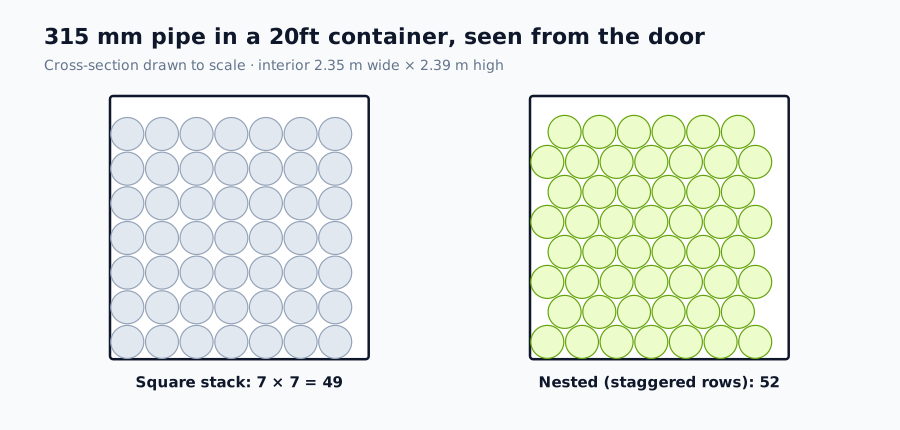
315 mm pipe in a 20ft container, drawn to scale. Nesting adds a course because each row sits only 0.87 diameters above the one below.
Nesting usually fits more pipe, because a nested row climbs only 0.87 of a diameter instead of a full one:
| Pipe OD | 20ft square | 20ft nested | Gain |
|---|---|---|---|
| 110 mm | 441 | 511 | +16% |
| 200 mm | 121 | 143 | +18% |
| 315 mm | 49 | 52 | +6% |
| 400 mm | 25 | 30 | +20% |
| 630 mm | 9 | 12 | +33% |
The gain depends on how the diameter divides into the container’s width and height, so it jumps around from size to size rather than following a smooth curve. The 315 mm row shows why: nesting gains a course, but every offset row loses one pipe at the edge.
Nesting is also the safer stow. A pipe resting in a groove is held on both sides. A pipe balanced on a single crown is held only by friction and the pipe beside it. The IMO/ILO/UNECE CTU Code (Annex 7) describes pipes stowed in the grooves of the tier beneath, and that is the stow the engine builds whenever it fits as many pipes as a grid.
Why steel pipe weighs out first
Steel line pipe is roughly ten times heavier per metre than plastic pipe of the same diameter. That flips the problem: you run out of payload while most of the box is still empty.
| Steel pipe (API 5L, Sch 40) | Weight | 20ft (5.8 m) | 40ft (11.8 m) |
|---|---|---|---|
| 6 in (168.3 × 7.11 mm) | 28.3 kg/m | 172 pipes, ~28.2 t | 80 pipes, ~26.7 t |
| 10 in (273.1 × 9.27 mm) | 60.3 kg/m | 79 pipes, ~27.6 t | 37 pipes, ~26.3 t |
Compare the 6-inch row across the two boxes. A 20ft carries about 998 m of pipe, and a 40ft carries about 944 m. The bigger container ships less pipe, because a 40ft is rated for less payload than a 20ft (26.7 t vs 28.2 t here). In the 40ft, those 80 pipes stack barely a metre high. This is why heavy steel usually moves in 20ft containers, and why the first number to check is the payload, not the volume. Our guide to container weight limits has the figures for each container type, and road limits can bite even earlier. See truck axle weight limits if the container travels by truck at either end.
Cut lengths to the container, not the other way round
The most common pipe-loading mistake happens before the container arrives: the pipe is cut to the wrong length.
- A 20ft container is 5.90 m long inside. A “6 metre” pipe does not fit. Cut to 5.8 m to leave room to load and to close the doors.
- A 40ft container is 12.03 m long inside. A 12 m pipe is a squeeze with no working room. 11.8 m is the usual container length.
- Mixed lengths should run as separate blocks, each starting from the front wall, so no short pipe ends up resting across two longer ones with nothing under its middle.
Pipes are loaded through the doors one at a time, so the door aperture (about 2.28 m high on a standard 20ft) limits the size of a single pipe or bundle, not the height of the stack.
Telescoping: shipping smaller pipe inside larger
For large-bore plastic pipe, the biggest saving is often inside the pipe itself. Telescoping (or nesting by bore) slides a smaller pipe inside a larger one, so a container of 630 mm pipe can also carry 400 or 500 mm pipe in the bores. The PPI Handbook of Polyethylene Pipe treats it as normal practice, with conditions:
- The inner pipe needs real clearance inside the host’s bore. The bore is the outside diameter minus twice the wall, and for SDR pipe that is OD × (1 − 2/SDR). A 630 mm SDR 17 pipe has a bore of about 556 mm, so a 500 mm pipe slides in, but a 560 mm pipe does not.
- The riders add weight to the host pipe. Count them when you check stack limits and payload.
- Steel pipe of unknown wall should not be telescoped on assumption. Measure the bore or use the mill data.
- Tell the consignee. Telescoped pipe has to be pulled out in order at the far end.
ContainerMath applies telescoping only where the bore actually clears, and states it on the plan, so the receiving warehouse knows what is inside what.
Securing a pipe stow
A full-width nested stack presses outward on the container walls, and round cargo wants to roll. The loading plan should cover four things:
- Chock the bottom course. Wedges on every outer bottom-row pipe, at least one eighth of the pipe’s diameter high (and never under 50 mm).
- Check the side walls. A nested stow leans on the walls. ISO container side walls are rated for 0.6 × payload spread evenly, and a pipe stack loads them along lines, not evenly. CTU Code Annex 7 calls for a side-wall check on nested pipe stows.
- Centre an incomplete top course. If the last course is part full, lay it in the middle of the stack, not against one wall, and block it front and back.
- Fill the door-end gap. Pipe shorter than the box leaves a gap at the doors. Brace it or fill it so the stack can’t slide back when the truck brakes.
The container stuffing guide covers the rest of the operation: sequence, tally, seal and VGM.
How to plan a pipe load
- List each pipe size: outside diameter, length, weight per length (or per metre) and quantity.
- Pick the container for the binding limit. Use a 20ft for heavy steel, and a 40ft or high cube for light plastic pipe.
- Let the engine build the nested stack and compare it with square stacking for your exact diameters. The gain ranges from nothing to about a third, by size.
- Check the weight result against the payload and any road leg.
- Print the plan with course counts, chocking and the load order, so the crew loads to the drawing.
ContainerMath runs the same steps across 50+ containers, trailers and railcars, including mixed diameters and mixed lengths in one load. Open the 3D load calculator to see how a plan is built.
Frequently asked questions
How many pipes fit in a 20ft container?
It depends on the diameter. In 5.8 m lengths, nested in staggered rows, a 20ft container holds about 511 pipes of 110 mm, 238 of 160 mm, 143 of 200 mm, 92 of 250 mm, 52 of 315 mm, 30 of 400 mm, 20 of 500 mm or 12 of 630 mm. Light plastic pipe fills the space first. Heavy steel pipe usually hits the payload limit first.
How many pipes fit in a 40ft container?
A standard 40ft has the same cross-section as a 20ft, so it holds the same number of pipes per size, each 11.8 m long instead of 5.8 m. A 40ft high cube adds one to three courses for most diameters, for example 574 instead of 511 lengths of 110 mm pipe, or 59 instead of 52 of 315 mm.
Will a 6 metre pipe fit in a 20ft container?
No. A 20ft container is about 5.90 m long inside, so a 6 m pipe will not fit. Pipe for 20ft containers is normally cut to 5.8 m, which leaves room to load and to close the doors.
Is nested or square stacking better for pipes?
Nested stacking, with each pipe in the groove between two below it, usually fits more pipe, by 6 to 33% in a 20ft depending on diameter. It is also more stable, because every pipe is held on both sides. Square stacking can only win when the diameter happens to divide the container’s width and height more cleanly.
Can you put smaller pipes inside larger pipes for shipping?
Yes, this is called telescoping. It is common for large-diameter plastic pipe, provided the inner pipe clears the host’s bore with room to slide. The added weight still counts toward the host pipe’s stack limit and the payload, and the receiver needs to know which pipes are inside which.
 ContainerMath
The industry standard for 3D container cargo packing and loading plans. Optimize layouts, maximize volume, and reduce shipping overhead.
Built by Backrock Studios