How Many Pallets Fit in a 20ft Container? (2026 Guide)
Last updated: 2026-06-22
Quick answer: A standard 20ft container holds about 11 Euro pallets (1200 × 800 mm) or 9 standard ISO pallets (1200 × 1000 mm) in a single ground layer. If your cargo can be double-stacked and stays under the weight limit, you can fit roughly 22 Euro or 18 standard pallets in total.
That’s about half what a 40ft container holds — but the 20ft is the right call for heavy, dense cargo that hits the weight limit long before it runs out of floor. The exact number depends on three things: the pallet footprint, whether you can stack, and the container’s payload limit. Let’s break it down.
Your pallets, your number. The counts above assume standard footprints in neat rows. Enter your actual pallet size, weight and quantity in ContainerMath to see your total volume and weight, how full a 20ft runs, and where each pallet goes. Free to try, no card. (For a quick floor layout of one pallet size, the free cargo load planner needs no signup.)
20ft container internal dimensions
Pallet counts come straight from the usable floor area. A standard (“dry”) 20ft container measures:
| Measurement | Metric | Imperial |
|---|---|---|
| Internal length | 5.90 m | 19’ 4" |
| Internal width | 2.35 m | 7’ 8" |
| Internal height | 2.39 m | 7’ 10" |
| Door opening (W × H) | 2.34 × 2.28 m | 7’ 8" × 7’ 6" |
| Floor area | ~13.9 m² | ~149 ft² |
| Volume capacity | ~33.2 m³ | ~1,172 ft³ |
| Max payload | ~28,200 kg | ~62,170 lb |
The 20ft shares its width and height with a 40ft — only the length is roughly halved. That matters: the same pallets tile across the width the same way, so a 20ft holds close to half a 40ft’s floor count. (For every container size side by side, see the shipping container dimensions guide.)
The two pallet sizes that matter
Almost every calculation comes down to one of these footprints:
- Euro pallet (EUR/EPAL): 1200 × 800 mm — the standard across Europe.
- Standard ISO pallet: 1200 × 1000 mm — the metric “industrial” pallet.
- US GMA pallet: 48 × 40 in (1219 × 1016 mm) — the North American grocery-and-general-freight standard. Close to the ISO pallet but not the same footprint, so it tiles differently.
Because the two have different footprints, they fill the container differently.
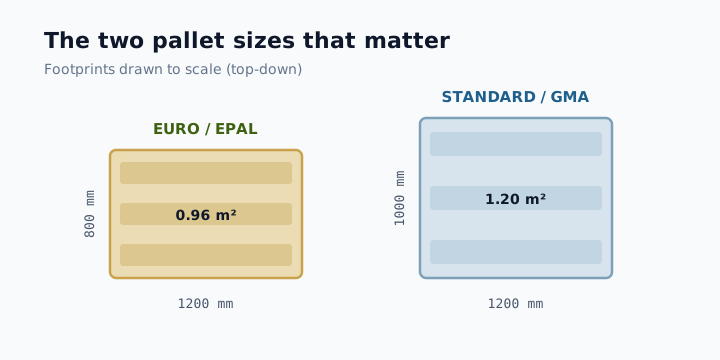
The Euro pallet’s smaller 0.96 m² base is exactly why more of them fit in the same container floor.
The math: pallets in a single layer
The container floor is 5.90 m long × 2.35 m wide. Here’s how each pallet type tiles into it:
Euro pallets (1200 × 800 mm) Mix orientations in two side-by-side columns. One column loads lengthwise — 1,200 mm along the container, 800 mm across — fitting 4 pallets along the 5.90 m floor. Beside it, a second column loads crosswise — 800 mm along, 1,200 mm across — fitting 7. Together the columns span 800 + 1,200 = 2,000 mm, well within the 2.35 m width, and 4 + 7 gives the industry-standard 11 Euro pallets per floor.
Standard pallets (1200 × 1000 mm) Two rows of 1000 mm across the width (2 × 1000 = 2000 mm) leave little waste, and 4 pallets of 1200 mm down the length gives 8 — turning one more into the leftover length lifts it to 9 standard pallets. Ten is not reachable: the 2352 mm width takes either two 1000 mm pallets or one 1200 mm pallet, and no arrangement of those beats nine.
| Pallet type | Footprint | Single layer | Double-stacked |
|---|---|---|---|
| Euro (EUR/EPAL) | 1200 × 800 mm | 11 | ~22 |
| Standard ISO | 1200 × 1000 mm | 9 | ~18 |
| US GMA | 1219 × 1016 mm | 9 | ~18 |
For reference, a 40ft container holds about 25 Euro or 20–22 standard pallets in a single layer — roughly double a 20ft. See how many pallets fit in a 40ft container.
When you can (and can’t) double-stack
Doubling the floor count assumes two things hold:
- Height fits. Two stacked pallets must clear the 2.39 m internal height. A 1.1 m-tall loaded pallet stacks fine; a 1.3 m one usually won’t in a standard 20ft.
- Weight stays under the limit. This is the constraint people forget — and it’s the reason to choose a 20ft. A 20ft caps out around 28,200 kg of payload. Across 22 pallets that’s only ~1,280 kg per pallet — so heavy goods hit the weight ceiling long before they run out of floor or height.
In practice, dense cargo (tiles, stone, liquids, machinery) is weight-limited and often ships in a 20ft to stay road-legal, while light, bulky cargo (textiles, packaging, foam) is volume-limited and usually wants a 40ft instead. Knowing which one you are tells you whether stacking actually helps — and which box to book.
Don’t load by rule of thumb — load by plan
These figures are starting points. Real shipments mix pallet sizes, have load-bearing and weight rules, and need a door-to-nose loading sequence. Eyeballing it leaves paid-for space empty or, worse, overloads an axle.
ContainerMath is a container load planner that works the exact problem in reverse: enter your carton or pallet dimensions and weights, and it computes a 3D loading plan — how many fit, where they go, and how much volume and payload you’re actually using. It supports 20ft, 40ft, 40ft HC, reefer, and truck/road vessels out of the box.
See it packed in 3D — free trial →
Frequently asked questions
How many Euro pallets fit in a 20ft container?
About 11 Euro pallets (1200 × 800 mm) in a single layer, and up to ~22 if the cargo can be safely double-stacked and stays under the container’s weight limit.
How many standard pallets fit in a 20ft container?
Around 9 standard ISO pallets (1200 × 1000 mm) on the floor, or roughly 18 double-stacked.
Is a 20ft or 40ft container better for pallets?
A 40ft holds about double the pallets, so it’s cheaper per pallet for light, bulky goods. But a 20ft is often the right choice for heavy, dense cargo that hits the ~28,200 kg payload limit well before it fills a 40ft.
What limits how many pallets I can load — space or weight?
Either. Light, bulky cargo runs out of volume first; dense, heavy cargo hits the ~28,200 kg payload limit first. Work out both before you book — a calculator that tracks volume and weight together will tell you which one binds.
 ContainerMath
The industry standard for 3D container cargo packing and loading plans. Optimize layouts, maximize volume, and reduce shipping overhead.
Built by Backrock Studios